DINGRANDAI
ProjectsAbout
Tiny Dent
Home/Projects/Software/Tiny Dent

Tiny Dent

A procedural sandbox where you reshape small planets, by hand or through autonomous robots, and watch the residents decide whether they like what you did.

TypeScriptReactThree.jsReact Three FiberZustandViteProcedural GenerationMarching CubesAgent-Based SimulationShadersGame DesignFirebase

Year

2026

Location

Ithaca, NY

Role

Game Designer

Overview

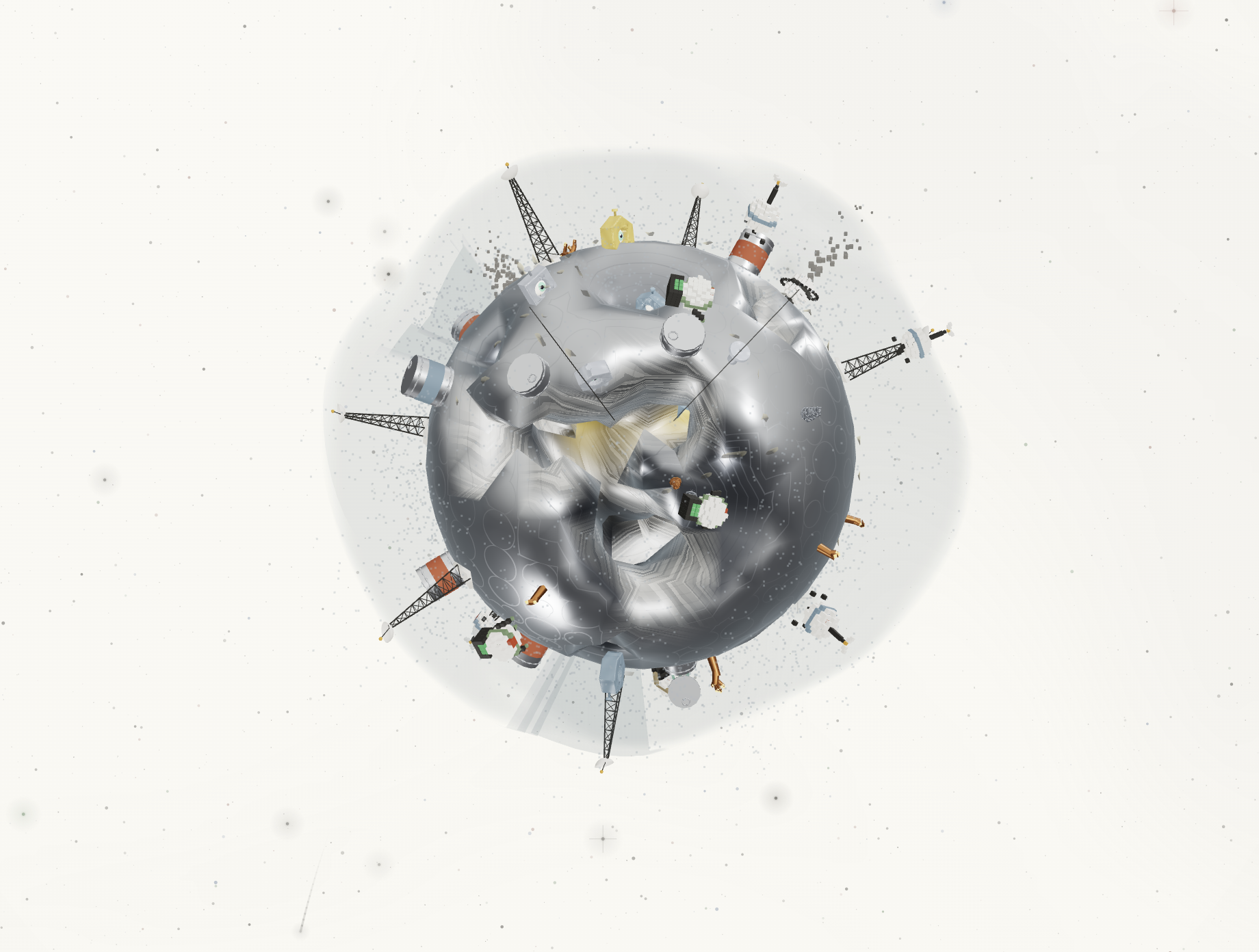
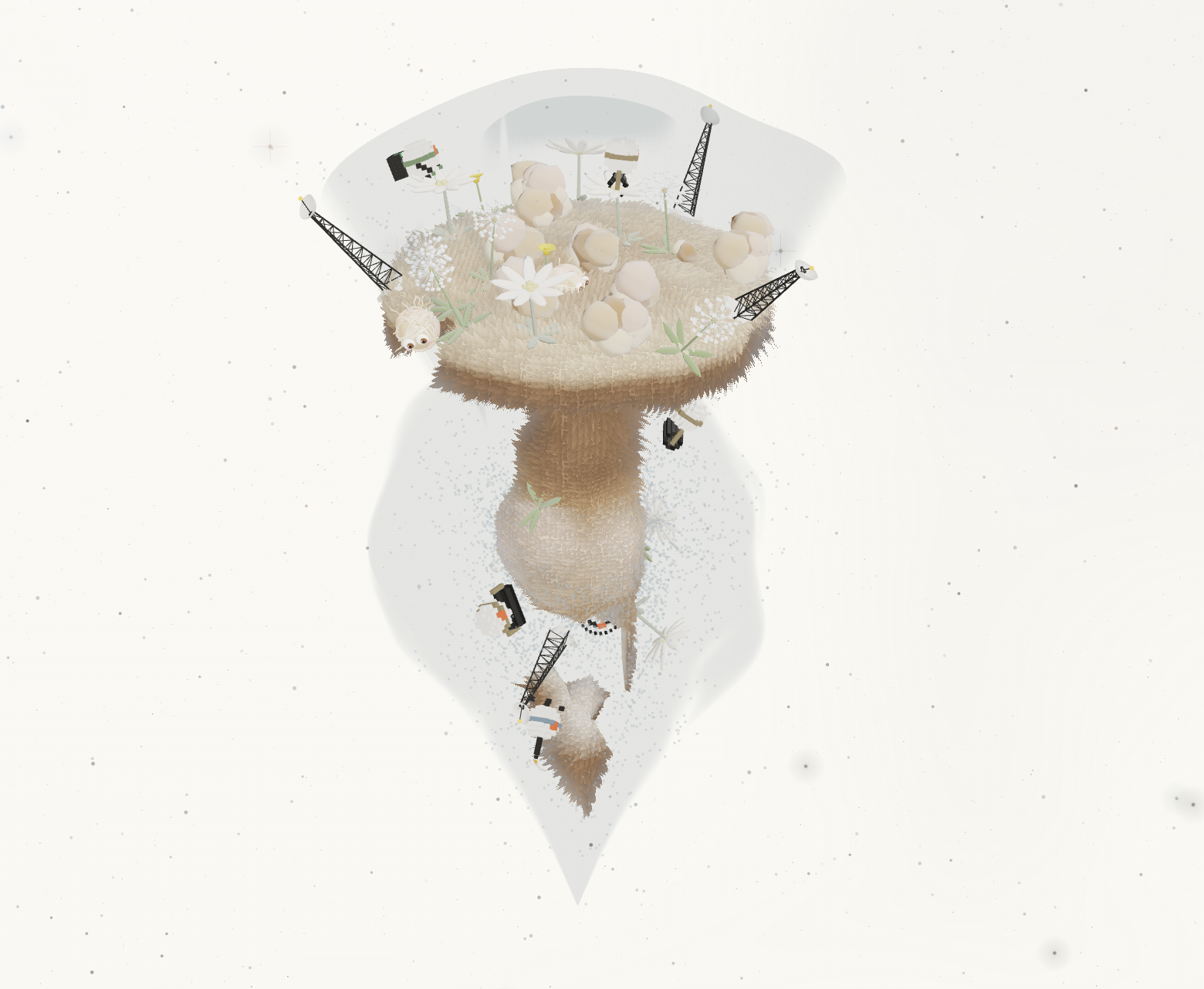
Tiny Dent is a procedural sandbox about small planets. Every planet starts from a seed: a shape, a mineral budget, a species of residents. You place robots, size their work areas, and let them carve, plant, and build. The planet changes, and the residents react: they shelter underground, peek out, tremble near robot work, and move toward quieter ground.

The residents "vote with their feet," so the consequences of your work are visible without the game declaring one ideal outcome. You may chase resources, grow flourishing habitats, or pursue strange planetary forms.

Play the Game ↗
Project Site ↗
View Source Code ↗

THE DECISION
What should the player's main verb be?
REJECTED
Dig the planet by hand, Astroneer-style
The world only changes as fast as the player clicks, and repeated manual digging hides the procedural systems underneath
CHOSEN
Delegate to robots that follow visible rules
The player sets goals and work areas; the interesting part becomes how the planet and its residents respond
Context

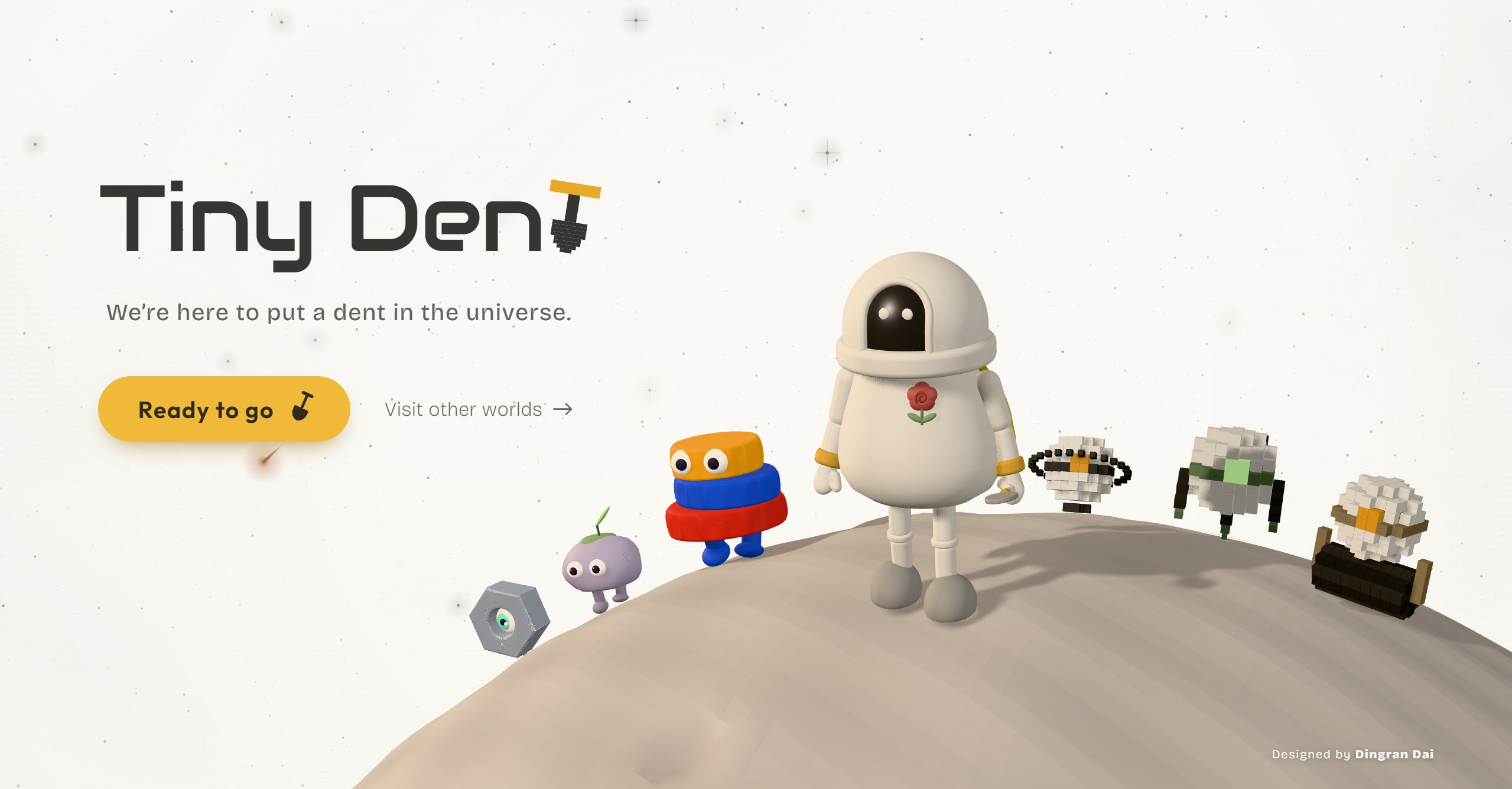
The project's tagline borrows from Steve Jobs: "We're here to put a dent in the universe." Here, the dent is literal, and the universe is small enough to watch it.

The Causal Chain

The whole design hangs on one chain of cause and effect:

planet starting conditions → player choices and robot work → environmental change → resident responses → different planetary outcomes

Resource extraction, ecological flourishing, and unusual shapes are all valid intentions. Migration is feedback, not an automatic failure.

The references set the scale and tone: Astroneer showed that a volumetric planet can be a soft, editable toy; Slipways framed a star system as a legible graph of worlds and routes; The Little Prince set the emotional target, a planet small enough that one change is visible from space and its inhabitants can be known individually.

How It Plays
  • Auto and Autopilot. Place a Miner, Gardener, Builder, or Rigger, size its spherical work area, and it works by itself. Autopilot hands the whole planet to the crew, which sweeps the surface sector by sector.
  • Manual. Dig, Add Terrain, Flatten, and a Detector that scans for Mineral, Life, and Memory signals.
  • Economy. Minerals sell on delivery, running robots draw billed electricity, manual edits cost credits, and a run ends in bankruptcy.
  • Signal planets. Once antennas stand, you can broadcast. Planets that answer become persistent sites with their own seeds and shapes, so each run grows into a small system of worlds.
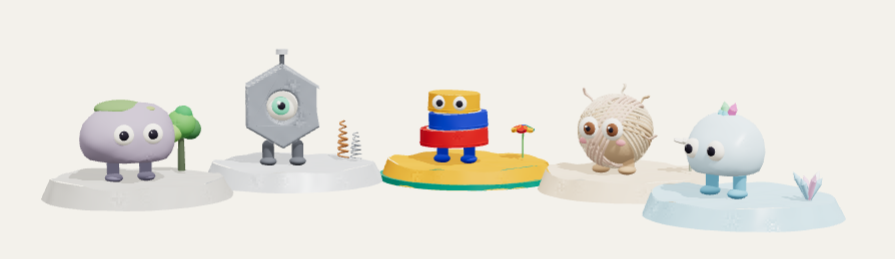
  • Residents. One species per planet, chosen from nine procedurally generated body directions.
How It's Made

The planet is a density field with a single sign rule (negative inside). A seeded sphere-plus-noise function builds it, every edit adds to or subtracts from it, and chunked Marching Cubes turns it into a mesh. Only the chunks an edit touches are rebuilt, and a three-level distance-based LOD with seam snapping keeps far terrain cheap while the full-resolution field stays the source of truth.

Everything else is rules over that field:

PartWhat it doesTechnique
PlanetSeeded shape, mineral deposits, per-planet variationDensity field, noise, seeded RNG
Terrain editingDig, add, flatten; affected chunks re-meshCSG on a density field, dirty-chunk remesh
MinerFinds minerals, flies a hover shell, carves tunnelsPath following, density subtraction
GardenerPlants on flat ground; plants spreadDistributions, slope filtering
BuilderCuts high ground, fills low ground with mined soilCut and fill
ResidentsShelter, peek, tremble, relocateDisturbance fields, walkable routes
LookVoxel-orb robots, contour-line terrain, point-cloud atmosphereShaders, particles

Stack: TypeScript, React 19, Three.js / React Three Fiber, Zustand, and Vite, deployed on Firebase Hosting.

System Architecture

The simulation is organized as 7 Planet Scale layers and 3 System Scale layers:

ScaleLayerTechnique
Planet1. Terrain & GeometryNoise, density field, Marching Cubes
Planet2. Materials & ResourcesSeeded distribution, surface patches
Planet3. Vegetation & InfrastructureSpatial sampling, growth rules
Planet4. Residents & HabitatAgent-based modeling, habitat suitability
Planet5. Colonies & Social GraphNeighborhood search, connected components
Planet6. Movement & RoadsA*, traffic heatmap, desire paths
Planet7. Local LogisticsTask allocation, resource accounting
System8. Planet NetworkGraph theory, procedural layout
System9. Transport & MigrationDijkstra, state machines
System10. EconomyStock–flow accounting, rule-based simulation

The layers feed back into each other. A migrant who dislikes the local material can request a familiar one from another planet; a Builder spends that delivery on a habitat patch; comfort and belonging are recalculated, deciding whether the resident settles or asks to go home. In another loop, traffic heat wears busy edges into roads, which lowers travel cost and shapes later route choices.

Design Process

The look was chosen before any robot was built. A component board compared visual options for every on-planet element over five rounds, each option a 3D model at game scale. The chosen set uses voxel-orb robots that differ by silhouette, contour-line terrain shaded by height and slope, and a point-cloud atmosphere. All colours come from one palette file, and a test fails if a model uses a colour outside it.

The residents followed the same method: nine body directions generated procedurally, compared on a design board, then one species per planet.

The player's traveller, the Quiet Drifter, started as an original turnaround sheet that fixes the part breakdown, joint pivots, local axes and material palette, so the character could be built procedurally from primitives and rigged at those pivots.

Outcome

Implemented: manual terrain editing, four robot roles, Autopilot, site accounting, surface exploration, persistent signal planets, per-planet material inventories, habitat preferences, derived colonies, surface pathfinding and traffic-driven roads, Builder habitat patches, interplanetary cargo and passenger routes, and resident passports and migration states.

The game ships alongside its project site on Firebase Hosting, with an automated test suite covering the simulation systems.

Limitations & Next Steps
  • Only the active planet runs a full local simulation; other planets keep snapshots that receive cargo and residents.
  • The economy is stock–flow accounting; dynamic supply-and-demand pricing is not implemented.
  • The end-of-run audit, planet classifications, and the Silent / Heard / Erased endings are still on the roadmap. Bankruptcy is currently the only way a run ends.
Home/Projects/Software/Tiny Dent

Tiny Dent

A procedural sandbox where you reshape small planets, by hand or through autonomous robots, and watch the residents decide whether they like what you did.

TypeScriptReactThree.jsReact Three FiberZustandViteProcedural GenerationMarching CubesAgent-Based SimulationShadersGame DesignFirebase

Year

2026

Location

Ithaca, NY

Role

Game Designer, Developer, Technical Artist

Overview

Tiny Dent is a procedural sandbox about small planets. Every planet starts from a seed: a shape, a mineral budget, a species of residents. You place robots, size their work areas, and let them carve, plant, and build. The planet changes, and the residents react: they shelter underground, peek out, tremble near robot work, and move toward quieter ground.

The residents "vote with their feet," so the consequences of your work are visible without the game declaring one ideal outcome. You may chase resources, grow flourishing habitats, or pursue strange planetary forms.

Play the Game ↗
Project Site ↗
View Source Code ↗

THE DECISION
What should the player's main verb be?
REJECTED
Dig the planet by hand, Astroneer-style
The world only changes as fast as the player clicks, and repeated manual digging hides the procedural systems underneath
CHOSEN
Delegate to robots that follow visible rules
The player sets goals and work areas; the interesting part becomes how the planet and its residents respond
Context

The project's tagline borrows from Steve Jobs: "We're here to put a dent in the universe." Here, the dent is literal, and the universe is small enough to watch it.

The Causal Chain

The whole design hangs on one chain of cause and effect:

planet starting conditions → player choices and robot work → environmental change → resident responses → different planetary outcomes

Resource extraction, ecological flourishing, and unusual shapes are all valid intentions. Migration is feedback, not an automatic failure.

The references set the scale and tone: Astroneer showed that a volumetric planet can be a soft, editable toy; Slipways framed a star system as a legible graph of worlds and routes; The Little Prince set the emotional target, a planet small enough that one change is visible from space and its inhabitants can be known individually.

How It Plays
  • Auto and Autopilot. Place a Miner, Gardener, Builder, or Rigger, size its spherical work area, and it works by itself. Autopilot hands the whole planet to the crew, which sweeps the surface sector by sector.
  • Manual. Dig, Add Terrain, Flatten, and a Detector that scans for Mineral, Life, and Memory signals.
  • Economy. Minerals sell on delivery, running robots draw billed electricity, manual edits cost credits, and a run ends in bankruptcy.
  • Signal planets. Once antennas stand, you can broadcast. Planets that answer become persistent sites with their own seeds and shapes, so each run grows into a small system of worlds.
  • Residents. One species per planet, chosen from nine procedurally generated body directions.
How It's Made

The planet is a density field with a single sign rule (negative inside). A seeded sphere-plus-noise function builds it, every edit adds to or subtracts from it, and chunked Marching Cubes turns it into a mesh. Only the chunks an edit touches are rebuilt, and a three-level distance-based LOD with seam snapping keeps far terrain cheap while the full-resolution field stays the source of truth.

Everything else is rules over that field:

PartWhat it doesTechnique
PlanetSeeded shape, mineral deposits, per-planet variationDensity field, noise, seeded RNG
Terrain editingDig, add, flatten; affected chunks re-meshCSG on a density field, dirty-chunk remesh
MinerFinds minerals, flies a hover shell, carves tunnelsPath following, density subtraction
GardenerPlants on flat ground; plants spreadDistributions, slope filtering
BuilderCuts high ground, fills low ground with mined soilCut and fill
ResidentsShelter, peek, tremble, relocateDisturbance fields, walkable routes
LookVoxel-orb robots, contour-line terrain, point-cloud atmosphereShaders, particles

Stack: TypeScript, React 19, Three.js / React Three Fiber, Zustand, and Vite, deployed on Firebase Hosting.

System Architecture

The simulation is organized as 7 Planet Scale layers and 3 System Scale layers:

ScaleLayerTechnique
Planet1. Terrain & GeometryNoise, density field, Marching Cubes
Planet2. Materials & ResourcesSeeded distribution, surface patches
Planet3. Vegetation & InfrastructureSpatial sampling, growth rules
Planet4. Residents & HabitatAgent-based modeling, habitat suitability
Planet5. Colonies & Social GraphNeighborhood search, connected components
Planet6. Movement & RoadsA*, traffic heatmap, desire paths
Planet7. Local LogisticsTask allocation, resource accounting
System8. Planet NetworkGraph theory, procedural layout
System9. Transport & MigrationDijkstra, state machines
System10. EconomyStock–flow accounting, rule-based simulation

The layers feed back into each other. A migrant who dislikes the local material can request a familiar one from another planet; a Builder spends that delivery on a habitat patch; comfort and belonging are recalculated, deciding whether the resident settles or asks to go home. In another loop, traffic heat wears busy edges into roads, which lowers travel cost and shapes later route choices.

Design Process

The look was chosen before any robot was built. A component board compared visual options for every on-planet element over five rounds, each option a 3D model at game scale. The chosen set uses voxel-orb robots that differ by silhouette, contour-line terrain shaded by height and slope, and a point-cloud atmosphere. All colours come from one palette file, and a test fails if a model uses a colour outside it.

The residents followed the same method: nine body directions generated procedurally, compared on a design board, then one species per planet.

The player's traveller, the Quiet Drifter, started as an original turnaround sheet that fixes the part breakdown, joint pivots, local axes and material palette, so the character could be built procedurally from primitives and rigged at those pivots.

Outcome

Implemented: manual terrain editing, four robot roles, Autopilot, site accounting, surface exploration, persistent signal planets, per-planet material inventories, habitat preferences, derived colonies, surface pathfinding and traffic-driven roads, Builder habitat patches, interplanetary cargo and passenger routes, and resident passports and migration states.

The game ships alongside its project site on Firebase Hosting, with an automated test suite covering the simulation systems.

Limitations & Next Steps
  • Only the active planet runs a full local simulation; other planets keep snapshots that receive cargo and residents.
  • The economy is stock–flow accounting; dynamic supply-and-demand pricing is not implemented.
  • The end-of-run audit, planet classifications, and the Silent / Heard / Erased endings are still on the roadmap. Bankruptcy is currently the only way a run ends.

Gallery

Gallery

Tiny Dent - Gallery 1
Tiny Dent - Gallery 2
Tiny Dent - Gallery 3
Keep exploring

Related Projects

01Same area
2026
Into Place

Software

Into Place

An archive-first, human-directed AI filmmaking platform for turning place memory into traceable collage films.

ReactTypeScript
02Other work
2024
Camino Quest

Creative

Camino Quest

A Data-Driven Interactive Board Game

Game Design
03Other work
2026
Prompt

Tangible

Prompt

A voice-first AI literacy game that teaches kids to spot the frame before it spots them.

Game Design

DINGRAN DAI © 2026

← Back to Projects