DINGRAN DAI
ProjectsAboutContact
Passive Self-Leveling Cup Holder
Home/Projects/Architecture & Fabrication/Passive Self-Leveling Cup Holder

Passive Self-Leveling Cup Holder

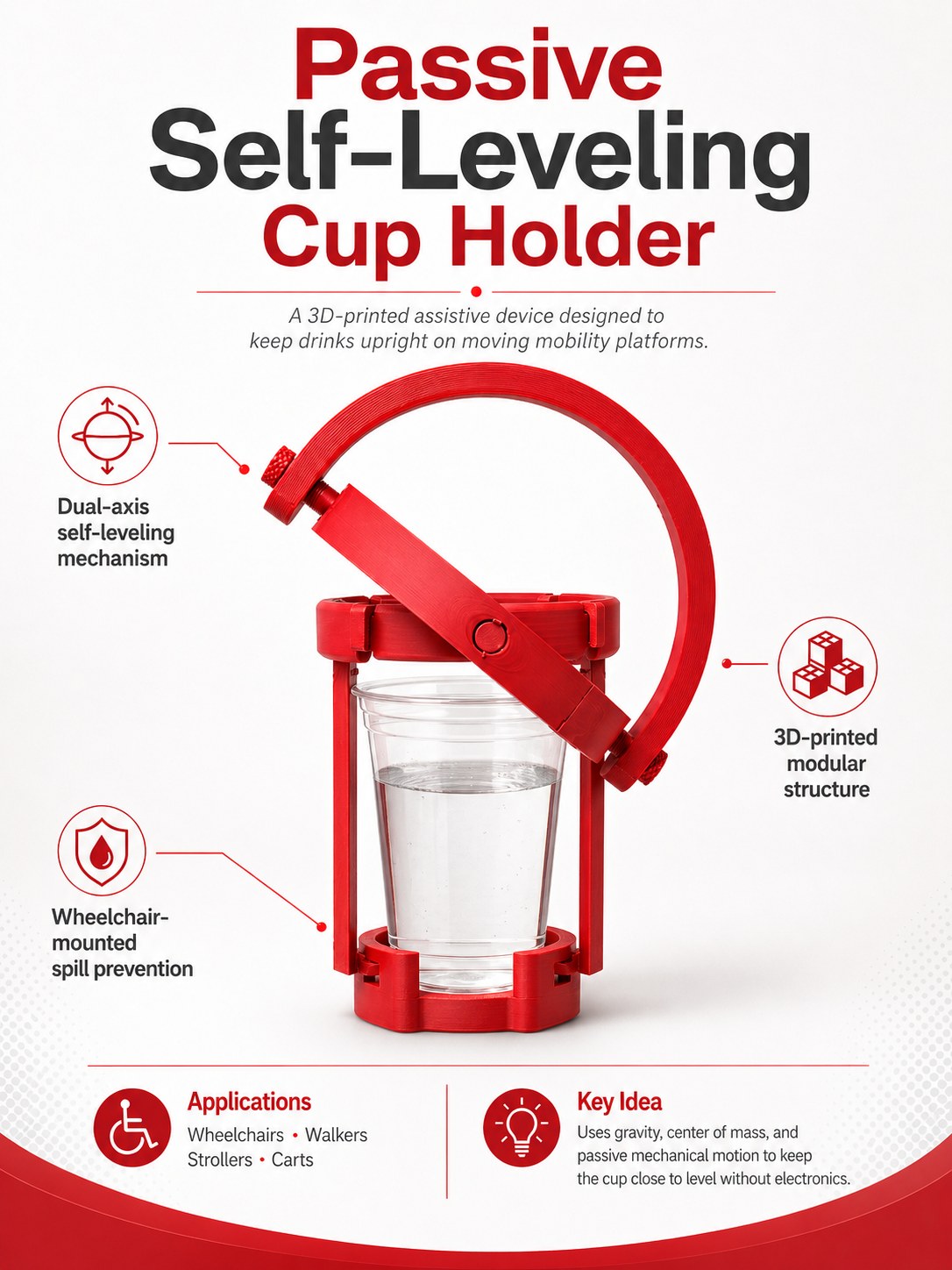
A 3D-printed dual-axis gimbal that keeps a drink upright on a moving wheelchair — no motors, no sensors, no code.

3D PrintingDigital FabricationCAD ModelingMechanical DesignRapid PrototypingAssistive DesignPhysical PrototypingDesign for Accessibility

Year

2026

Location

New York, NY

Role

Assembly & Testing

Portfolio

Passive Self-Leveling Cup Holder - Portfolio 1
1/1

Tap to enlarge • Scroll to view

Overview

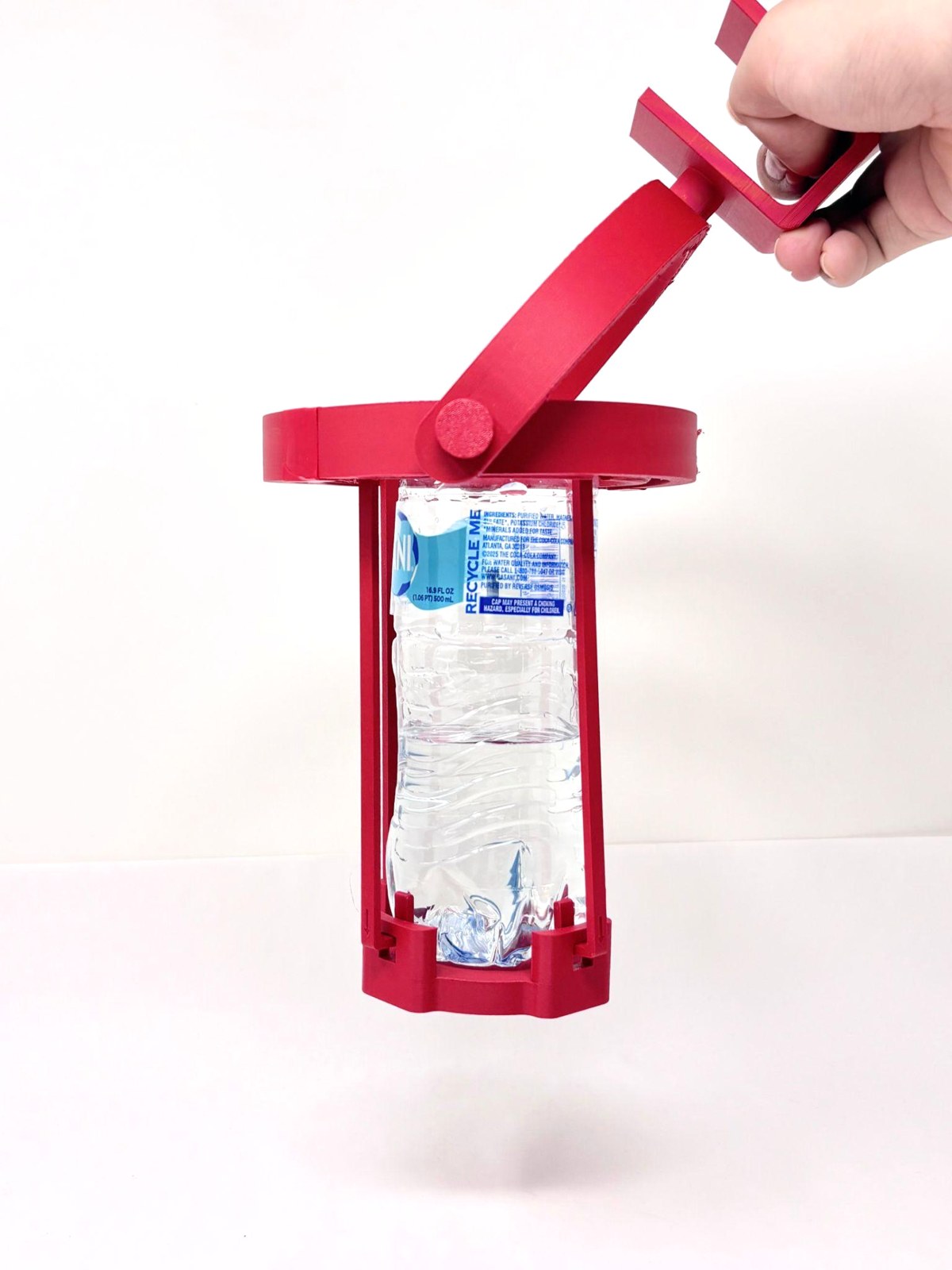
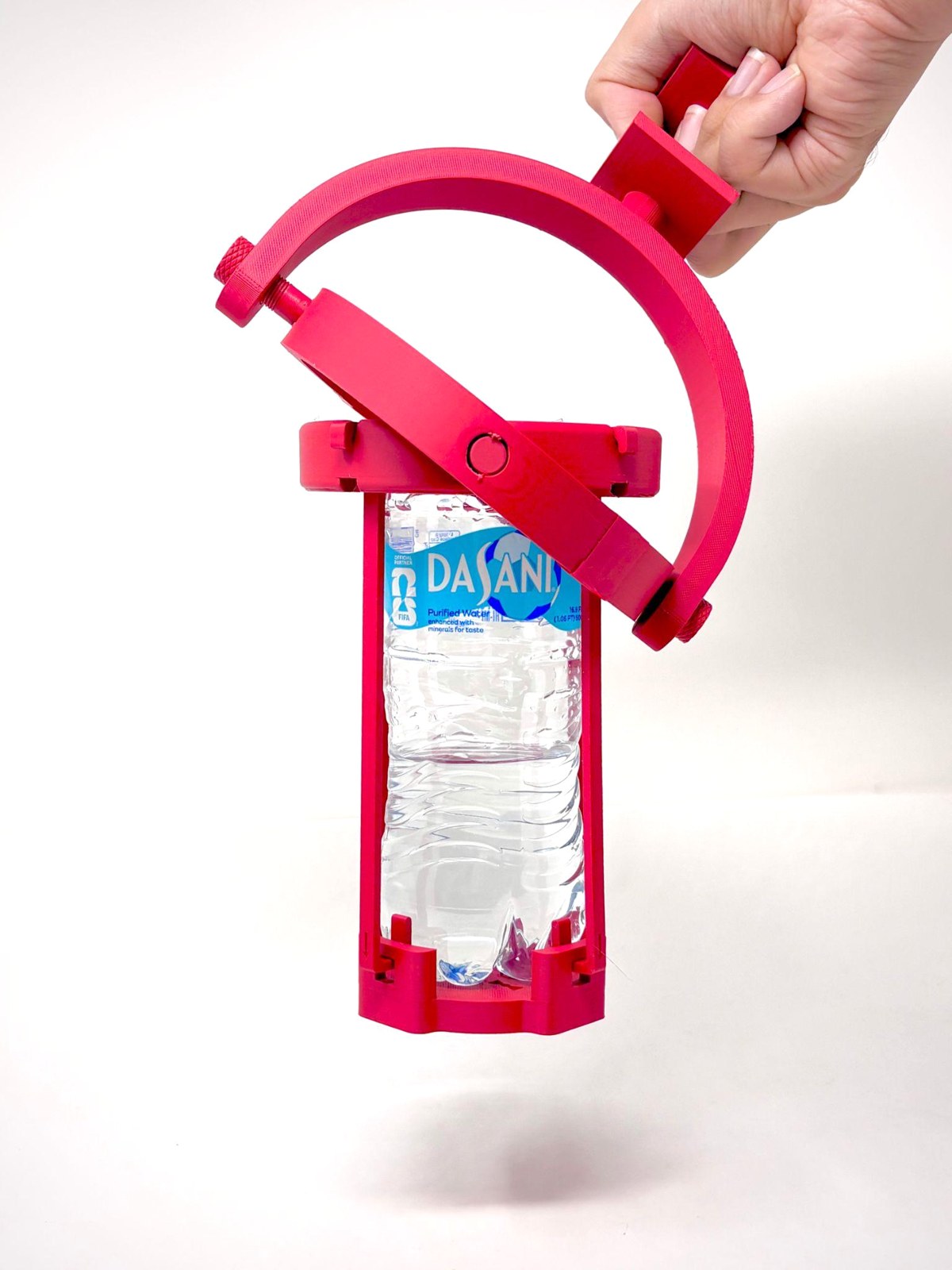
Passive Self-Leveling Cup Holder is a 3D-printed assistive device that keeps a drink upright while a wheelchair moves, turns, or tilts.

A fixed cup holder is rigidly attached to the frame, so every threshold, ramp, and sudden turn is transmitted straight into the cup. This project replaces that rigid connection with a two-axis universal joint and a low-hanging counterweighted base, so the cup stays close to level using nothing but gravity and geometry — no motors, no sensors, no control software.

Every component, including the screws, was fabricated by 3D printing. The threads were modeled directly into the parts, so no tapping or off-the-shelf hardware was required.


THE DECISION
Should the cup sit on top of the leveling ring, or hang below it?
REJECTED
Cup seated on top of the gimbal ring
Puts the mass above the pivot, so the whole assembly wobbles and the cup can slide out under sudden motion
CHOSEN
Cup suspended below the rotation center, with the base doubling as counterweight
Gravity does the correcting work: a low center of mass returns the cup to level on its own, and the vertical frame supports the cup along its full height
The stabilization is not controlled — it is designed into the geometry.
Context & Motivation

Carrying a drink is one of the small, ordinary tasks that becomes disproportionately difficult on a moving mobility device. Hot coffee on a wheelchair is not just inconvenient when it spills — it is a safety problem.

The design question was deliberately narrow:

How much stability can be achieved through pure mechanical design, without adding electronics that need power, calibration, or maintenance?

Passive stabilization matters here because an assistive device that depends on a battery is an assistive device that eventually fails at the wrong moment. A gimbal, by contrast, works the same way on its first day and its thousandth.


Mechanism

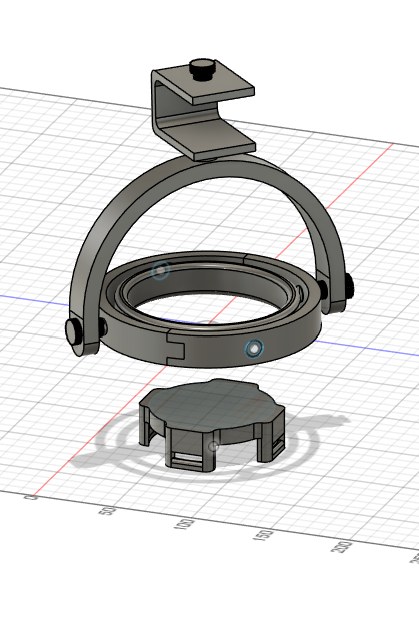
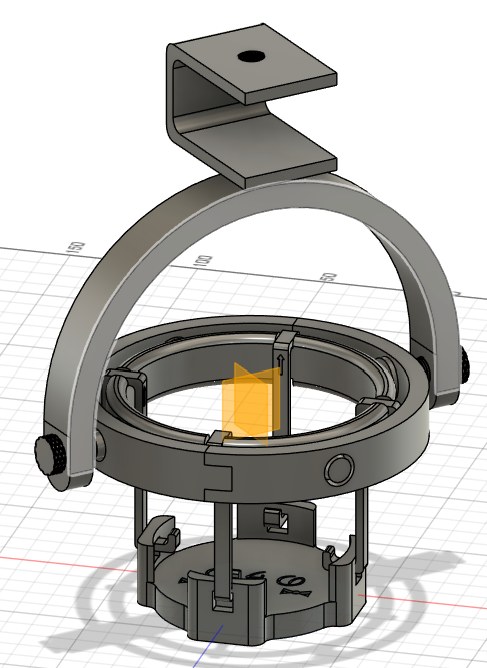
The device is built around four elements:

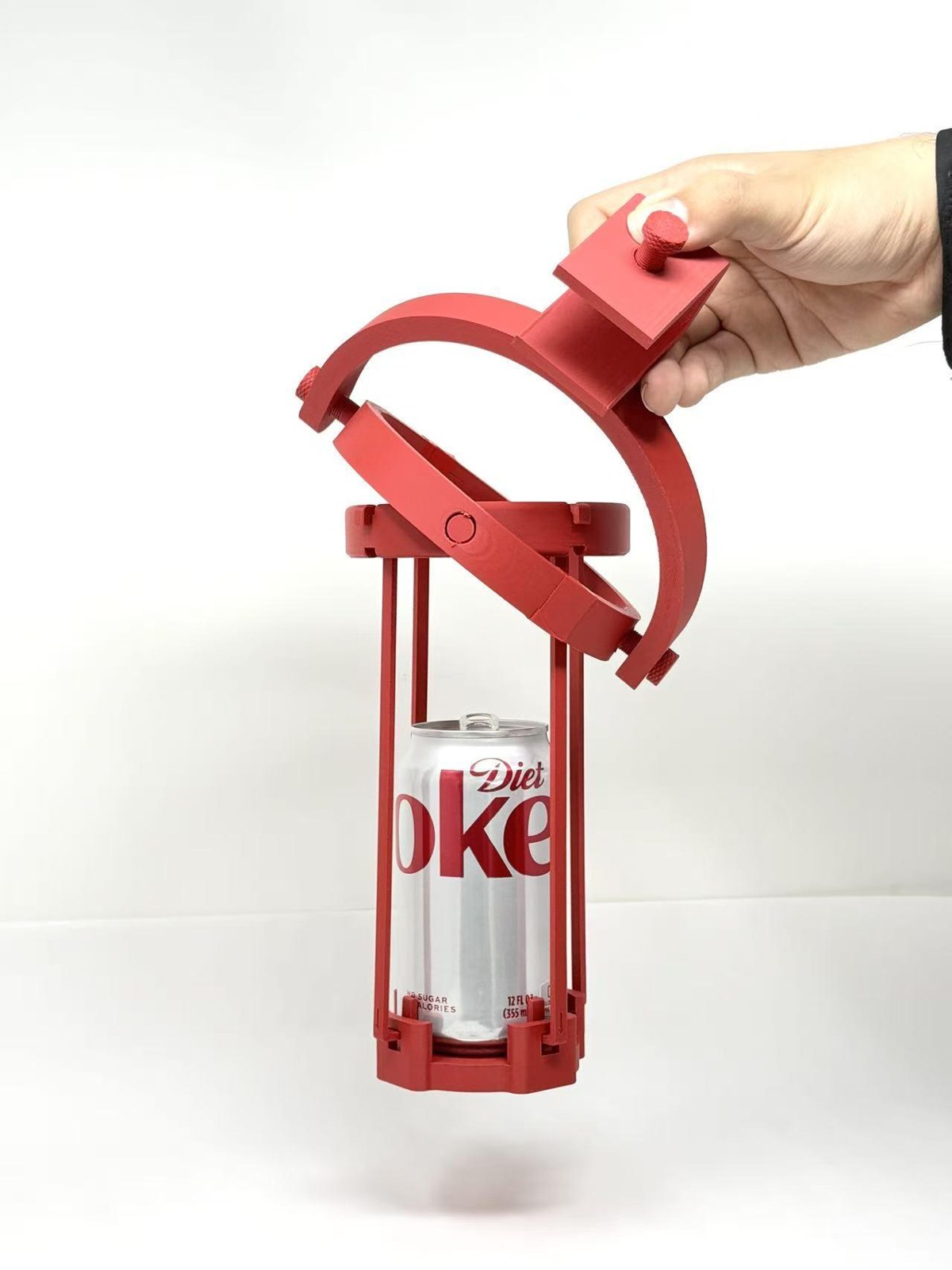
  • Outer ring — pivots on the frame around the first horizontal axis
  • Inner ring — pivots inside the outer ring around a second, perpendicular axis
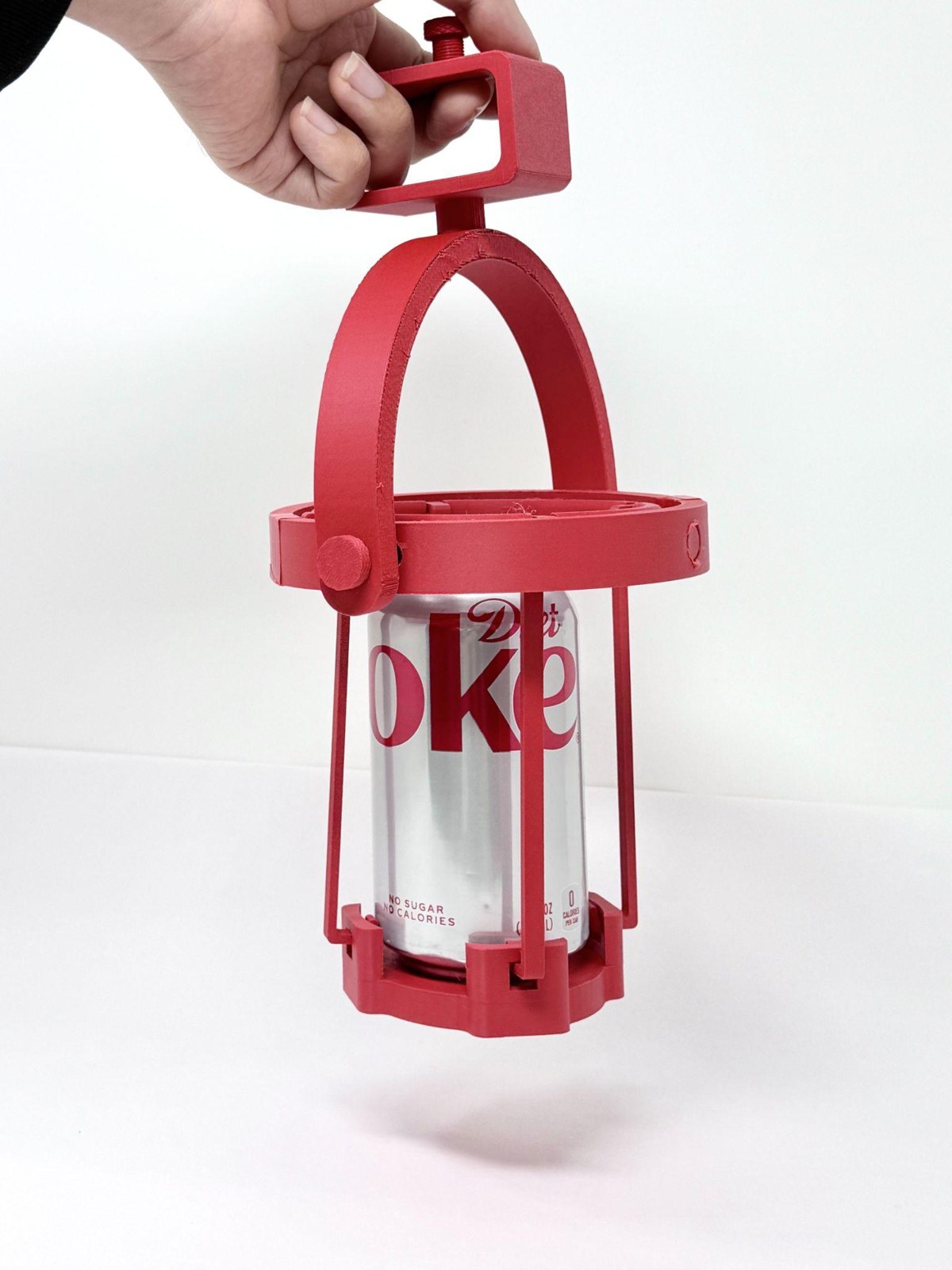
  • Suspended base — hangs below the rotation center on hooks, holding the cup and acting as the counterweight
  • Frame and clamp — mounts the assembly to a wheelchair side frame, armrest, or handlebar

Because the two rotation axes are perpendicular and the mass sits below the intersection point, tilting the mount in any direction produces a restoring torque. The cup simply stays where gravity puts it while the frame moves around it.

The counterweight is adjustable, which allowed the center of mass to be tuned for different cup sizes and fill levels.


Fabrication

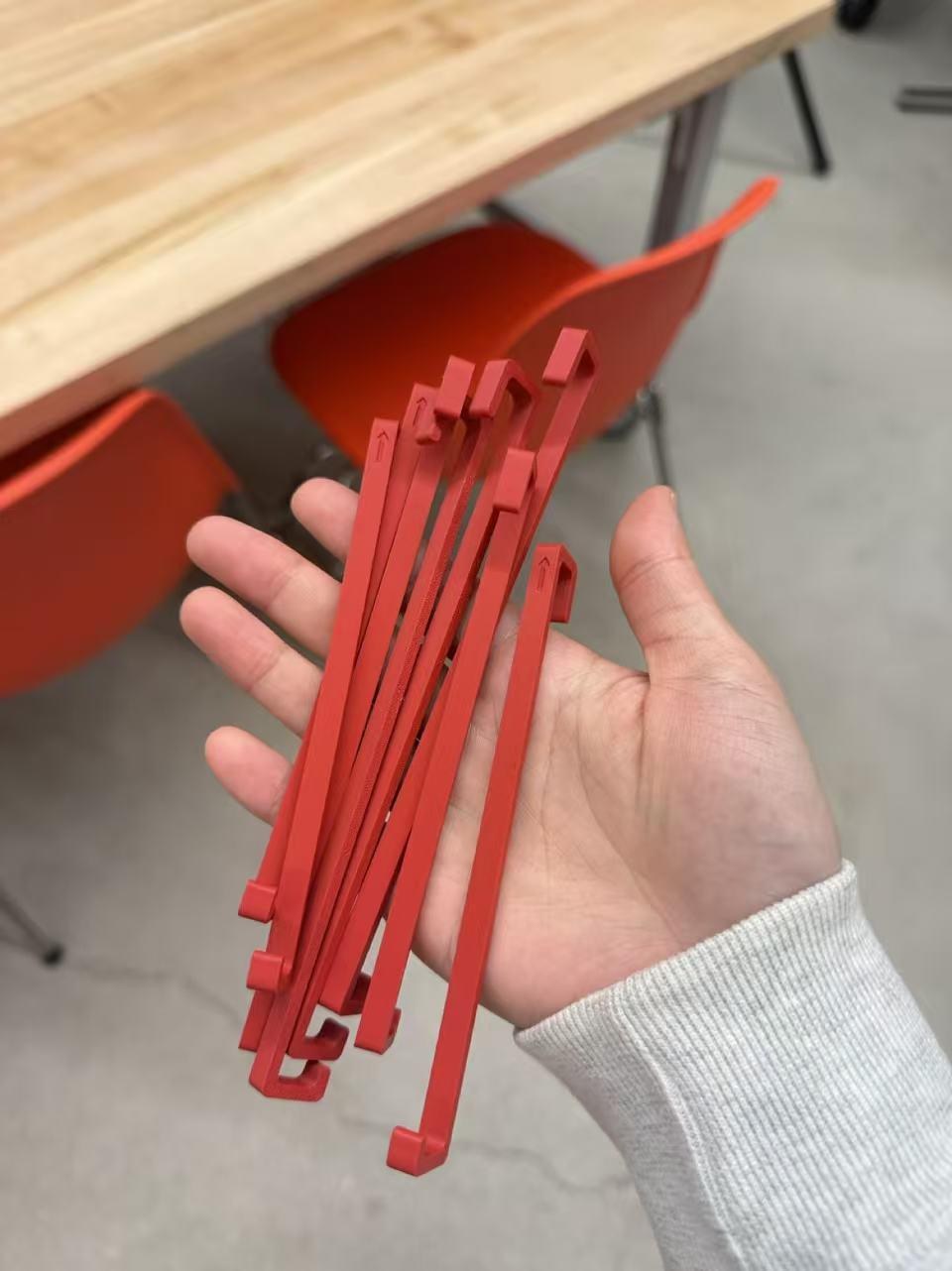
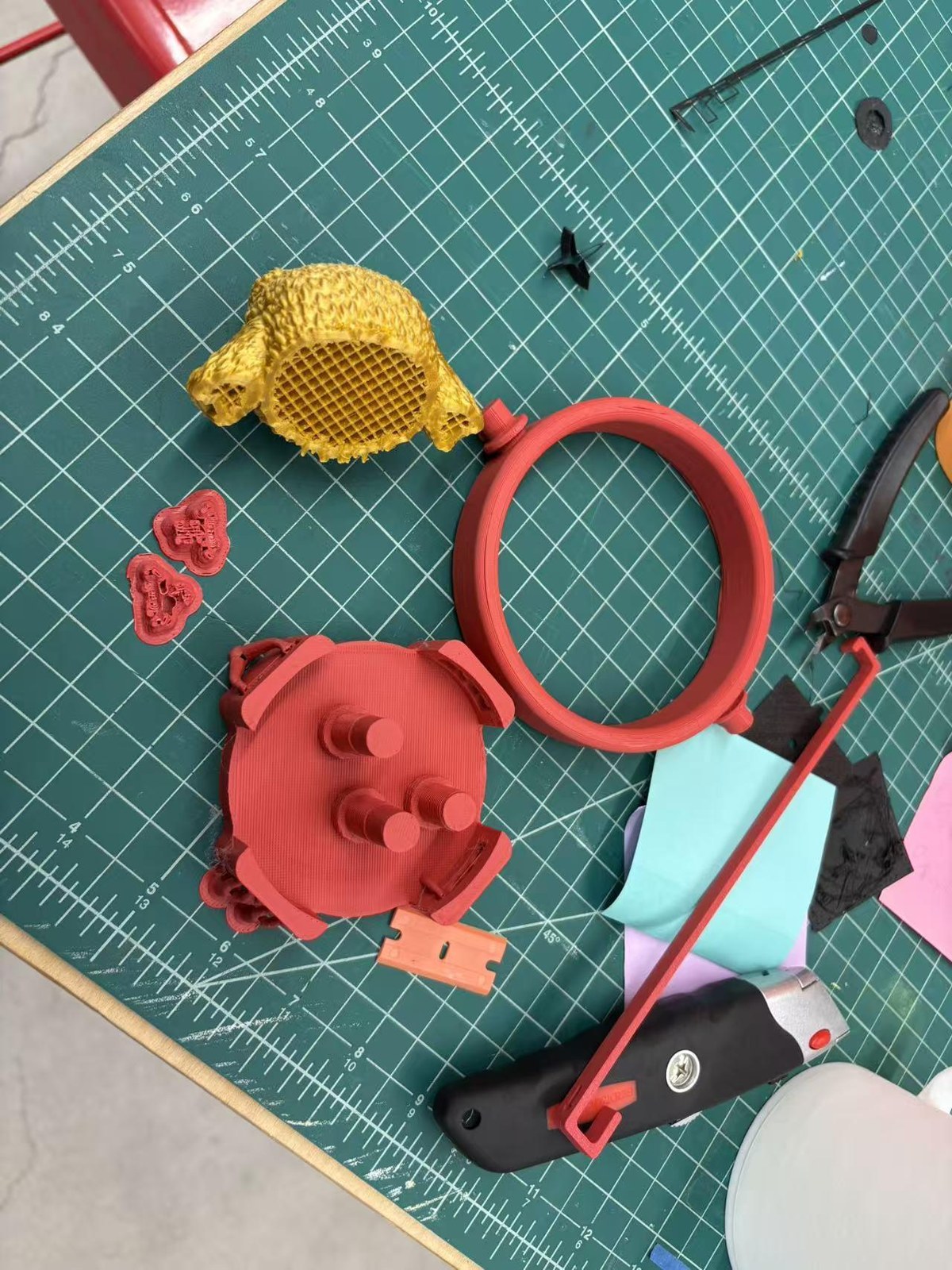
All parts were printed in PLA, including custom-threaded long and short screws. The long screws pass through the frame and serve double duty: the threaded section fastens into the frame, while the smooth section becomes the outer rotation axis.

Fabrication constraints drove several design choices:

  • Part thickness and wall counts were tuned so thin ring sections would not delaminate under load
  • Print orientation was chosen to keep layer lines perpendicular to the main stress paths
  • Tolerances at every pivot were revised after each print — too tight and the gimbal binds, too loose and the cup wobbles

Printing the fasteners rather than buying them kept the whole device to a single material and a single process, which also makes it easier to reproduce.


Design Iteration

The first prototype placed the cup on top of the leveling ring. It proved the balancing principle but failed as a product: the mass sat above the pivot, so the assembly wobbled; the cup was unsupported along its height and could slide out; and two bulky side walls limited the rotation range while making the object read as a tabletop demo rather than a mounted device.

The redesign inverted the logic. The cup was moved below the rotation center into a tall, open vertical frame, with a large external arc, a diagonal rotating arm, and a top clamp for mounting. This lowered the center of mass, supported the cup along its full height, widened the range of motion, and made the self-leveling behavior legible at a glance.

Several further rounds of printing and assembly followed, adjusting thickness, tolerance, joint friction, cup position, and structural strength after each test.


Testing

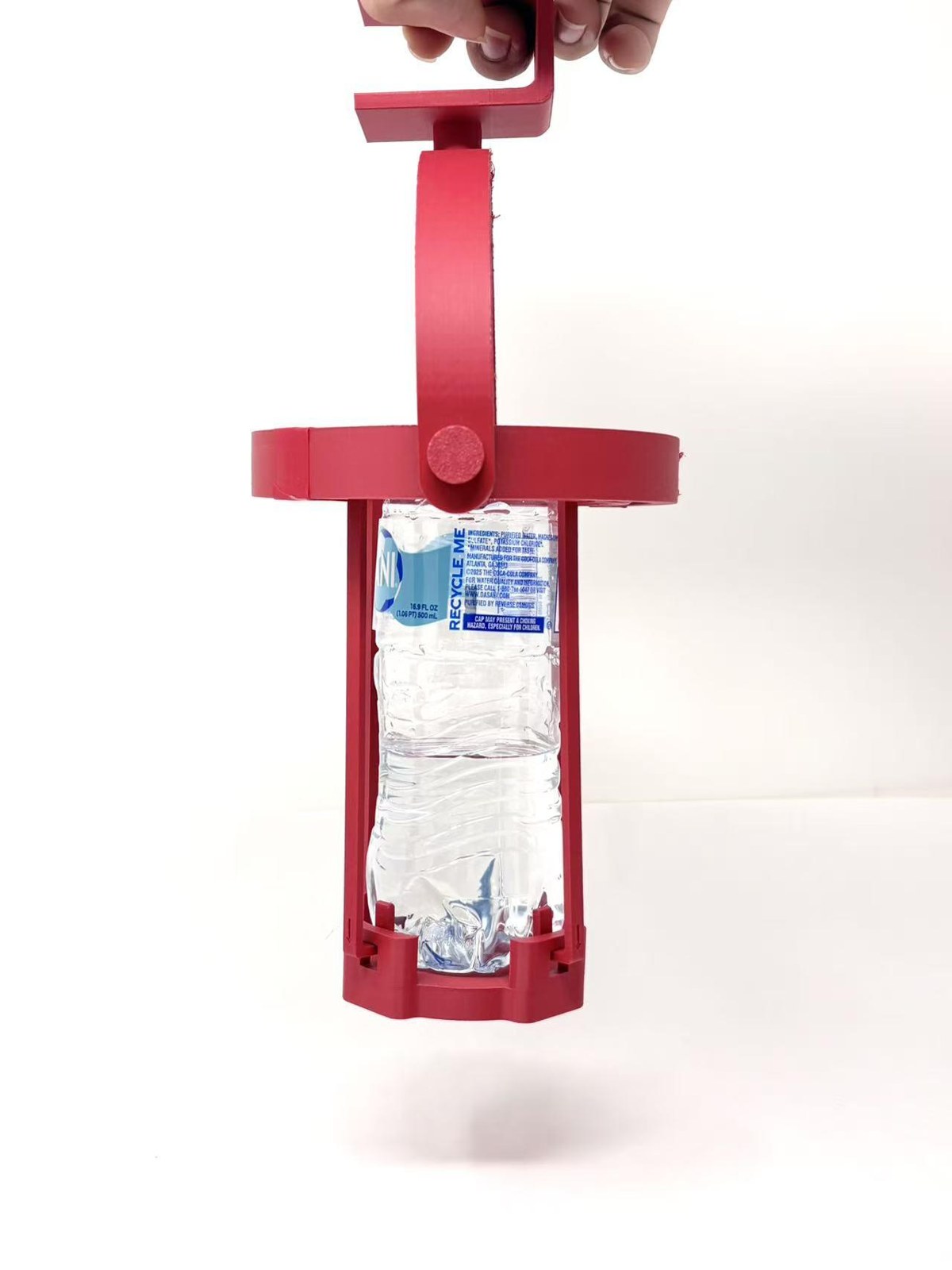
Testing focused on how the holder behaves at increasing base angles and under different loads. With a filled bottle in place, the frame could be rotated well past typical ramp and threshold angles while the cup remained close to vertical.

Two properties turned out to be harder to tune than expected:

  • Friction — tight joints resist correction; loose joints let the cup oscillate. The working range between the two is narrower than it looks on screen.
  • Damping — too little and the holder swings for a long time after a disturbance; too much and it stops correcting altogether.

Stop structures were added on the axes to bound the travel, and joint spacing and alignment were adjusted between prints.

The clearest remaining defect is axial play between the printed screws and the outer ring, which lets the suspended assembly slide slightly and settle off-level. Tighter tolerance design — or printed bushings and smoother shafts — is the obvious next step.


Outcome

The project produced:

  • A working, fully 3D-printed dual-axis self-leveling cup holder, fasteners included
  • A mounting system that attaches to a wheelchair frame, armrest, or handlebar
  • A tested set of tolerances and print orientations for compliant printed pivots
  • An exhibition setup where visitors can tilt the mount themselves and watch the cup stay upright

The same mechanism transfers directly to walkers, strollers, carts, bicycle handlebars, and mobile workstations.

Demo video →


Reflection

Working on this project changed how I think about stability in physical design. My instinct at the start was to reach for correction — something that senses tilt and responds. The more useful move turned out to be arranging mass and axes so that no correction is needed at all.

What I take from it:

  • Passive systems fail more gracefully than active ones, which matters enormously in assistive design
  • Tolerance is a design decision, not a print setting — most of our problems lived in the gaps between parts
  • Testing on a real wheelchair frame, early, would have caught the mounting issues weeks before we did

The next version would prioritize a measurable test rig — controlled tilt angle, recovery time, and spill threshold — so improvements can be compared rather than judged by feel.
Home/Projects/Architecture & Fabrication/Passive Self-Leveling Cup Holder

Passive Self-Leveling Cup Holder

A 3D-printed dual-axis gimbal that keeps a drink upright on a moving wheelchair — no motors, no sensors, no code.

3D PrintingDigital FabricationCAD ModelingMechanical DesignRapid PrototypingAssistive DesignPhysical PrototypingDesign for Accessibility

Year

2026

Location

New York, NY

Role

Assembly & Testing, Materials & Fabrication, Documentation, Presentation Design

Overview

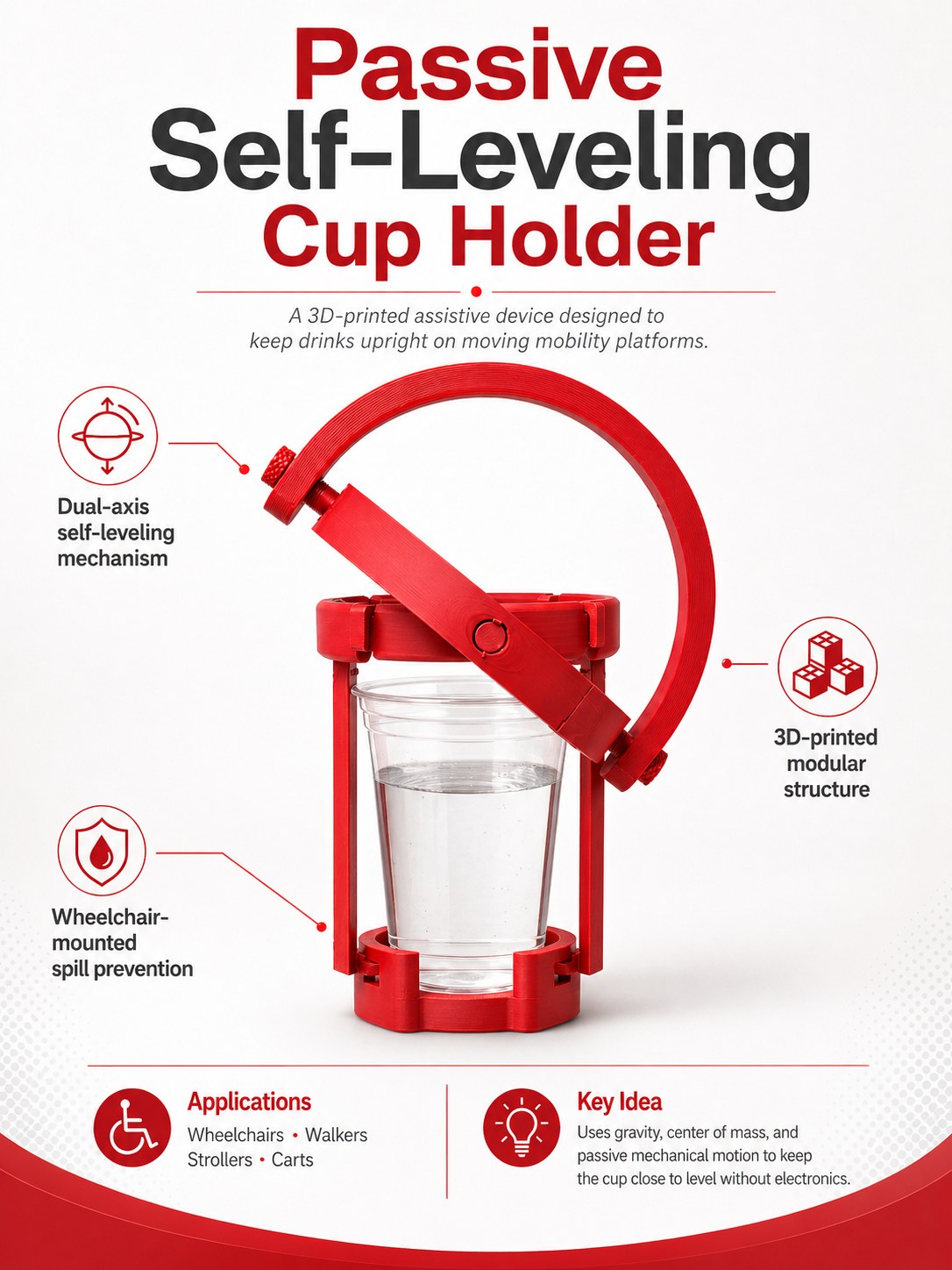
Passive Self-Leveling Cup Holder is a 3D-printed assistive device that keeps a drink upright while a wheelchair moves, turns, or tilts.

A fixed cup holder is rigidly attached to the frame, so every threshold, ramp, and sudden turn is transmitted straight into the cup. This project replaces that rigid connection with a two-axis universal joint and a low-hanging counterweighted base, so the cup stays close to level using nothing but gravity and geometry — no motors, no sensors, no control software.

Every component, including the screws, was fabricated by 3D printing. The threads were modeled directly into the parts, so no tapping or off-the-shelf hardware was required.


THE DECISION
Should the cup sit on top of the leveling ring, or hang below it?
REJECTED
Cup seated on top of the gimbal ring
Puts the mass above the pivot, so the whole assembly wobbles and the cup can slide out under sudden motion
CHOSEN
Cup suspended below the rotation center, with the base doubling as counterweight
Gravity does the correcting work: a low center of mass returns the cup to level on its own, and the vertical frame supports the cup along its full height
The stabilization is not controlled — it is designed into the geometry.
Context & Motivation

Carrying a drink is one of the small, ordinary tasks that becomes disproportionately difficult on a moving mobility device. Hot coffee on a wheelchair is not just inconvenient when it spills — it is a safety problem.

The design question was deliberately narrow:

How much stability can be achieved through pure mechanical design, without adding electronics that need power, calibration, or maintenance?

Passive stabilization matters here because an assistive device that depends on a battery is an assistive device that eventually fails at the wrong moment. A gimbal, by contrast, works the same way on its first day and its thousandth.


Mechanism

The device is built around four elements:

  • Outer ring — pivots on the frame around the first horizontal axis
  • Inner ring — pivots inside the outer ring around a second, perpendicular axis
  • Suspended base — hangs below the rotation center on hooks, holding the cup and acting as the counterweight
  • Frame and clamp — mounts the assembly to a wheelchair side frame, armrest, or handlebar

Because the two rotation axes are perpendicular and the mass sits below the intersection point, tilting the mount in any direction produces a restoring torque. The cup simply stays where gravity puts it while the frame moves around it.

The counterweight is adjustable, which allowed the center of mass to be tuned for different cup sizes and fill levels.


Fabrication

All parts were printed in PLA, including custom-threaded long and short screws. The long screws pass through the frame and serve double duty: the threaded section fastens into the frame, while the smooth section becomes the outer rotation axis.

Fabrication constraints drove several design choices:

  • Part thickness and wall counts were tuned so thin ring sections would not delaminate under load
  • Print orientation was chosen to keep layer lines perpendicular to the main stress paths
  • Tolerances at every pivot were revised after each print — too tight and the gimbal binds, too loose and the cup wobbles

Printing the fasteners rather than buying them kept the whole device to a single material and a single process, which also makes it easier to reproduce.


Design Iteration

The first prototype placed the cup on top of the leveling ring. It proved the balancing principle but failed as a product: the mass sat above the pivot, so the assembly wobbled; the cup was unsupported along its height and could slide out; and two bulky side walls limited the rotation range while making the object read as a tabletop demo rather than a mounted device.

The redesign inverted the logic. The cup was moved below the rotation center into a tall, open vertical frame, with a large external arc, a diagonal rotating arm, and a top clamp for mounting. This lowered the center of mass, supported the cup along its full height, widened the range of motion, and made the self-leveling behavior legible at a glance.

Several further rounds of printing and assembly followed, adjusting thickness, tolerance, joint friction, cup position, and structural strength after each test.


Testing

Testing focused on how the holder behaves at increasing base angles and under different loads. With a filled bottle in place, the frame could be rotated well past typical ramp and threshold angles while the cup remained close to vertical.

Two properties turned out to be harder to tune than expected:

  • Friction — tight joints resist correction; loose joints let the cup oscillate. The working range between the two is narrower than it looks on screen.
  • Damping — too little and the holder swings for a long time after a disturbance; too much and it stops correcting altogether.

Stop structures were added on the axes to bound the travel, and joint spacing and alignment were adjusted between prints.

The clearest remaining defect is axial play between the printed screws and the outer ring, which lets the suspended assembly slide slightly and settle off-level. Tighter tolerance design — or printed bushings and smoother shafts — is the obvious next step.


Outcome

The project produced:

  • A working, fully 3D-printed dual-axis self-leveling cup holder, fasteners included
  • A mounting system that attaches to a wheelchair frame, armrest, or handlebar
  • A tested set of tolerances and print orientations for compliant printed pivots
  • An exhibition setup where visitors can tilt the mount themselves and watch the cup stay upright

The same mechanism transfers directly to walkers, strollers, carts, bicycle handlebars, and mobile workstations.

Demo video →


Reflection

Working on this project changed how I think about stability in physical design. My instinct at the start was to reach for correction — something that senses tilt and responds. The more useful move turned out to be arranging mass and axes so that no correction is needed at all.

What I take from it:

  • Passive systems fail more gracefully than active ones, which matters enormously in assistive design
  • Tolerance is a design decision, not a print setting — most of our problems lived in the gaps between parts
  • Testing on a real wheelchair frame, early, would have caught the mounting issues weeks before we did

The next version would prioritize a measurable test rig — controlled tilt angle, recovery time, and spill threshold — so improvements can be compared rather than judged by feel.
Portfolio

Passive Self-Leveling Cup Holder - Portfolio 1

Gallery

Gallery

Passive Self-Leveling Cup Holder - Gallery 1
Passive Self-Leveling Cup Holder - Gallery 2
Passive Self-Leveling Cup Holder - Gallery 3
Passive Self-Leveling Cup Holder - Gallery 4
Passive Self-Leveling Cup Holder - Gallery 5
Passive Self-Leveling Cup Holder - Gallery 6
Passive Self-Leveling Cup Holder - Gallery 7
Passive Self-Leveling Cup Holder - Gallery 8
Passive Self-Leveling Cup Holder - Gallery 9
Keep exploring

Related Projects

View all projects
01Same area
2024
3D Printed Bamboo Structure

Architecture & Fabrication

3D Printed Bamboo Structure

Parametric Joints for Modular Bamboo Construction

3D PrintingDigital Fabrication
02Same area
2021
DuPont Paper and Plywood Art Installation Wall

Architecture & Fabrication

DuPont Paper and Plywood Art Installation Wall

A Low-Cost Spatial Installation Using Hybrid Materials

Digital Fabrication
03Other work
2025
Interactive Pocket Parks

Creative Media

Interactive Pocket Parks

Data-Driven Urban Interaction for Micro Public Spaces

3D Printing

© 2026 Dingran Dai. All rights reserved.

← Back to Projects